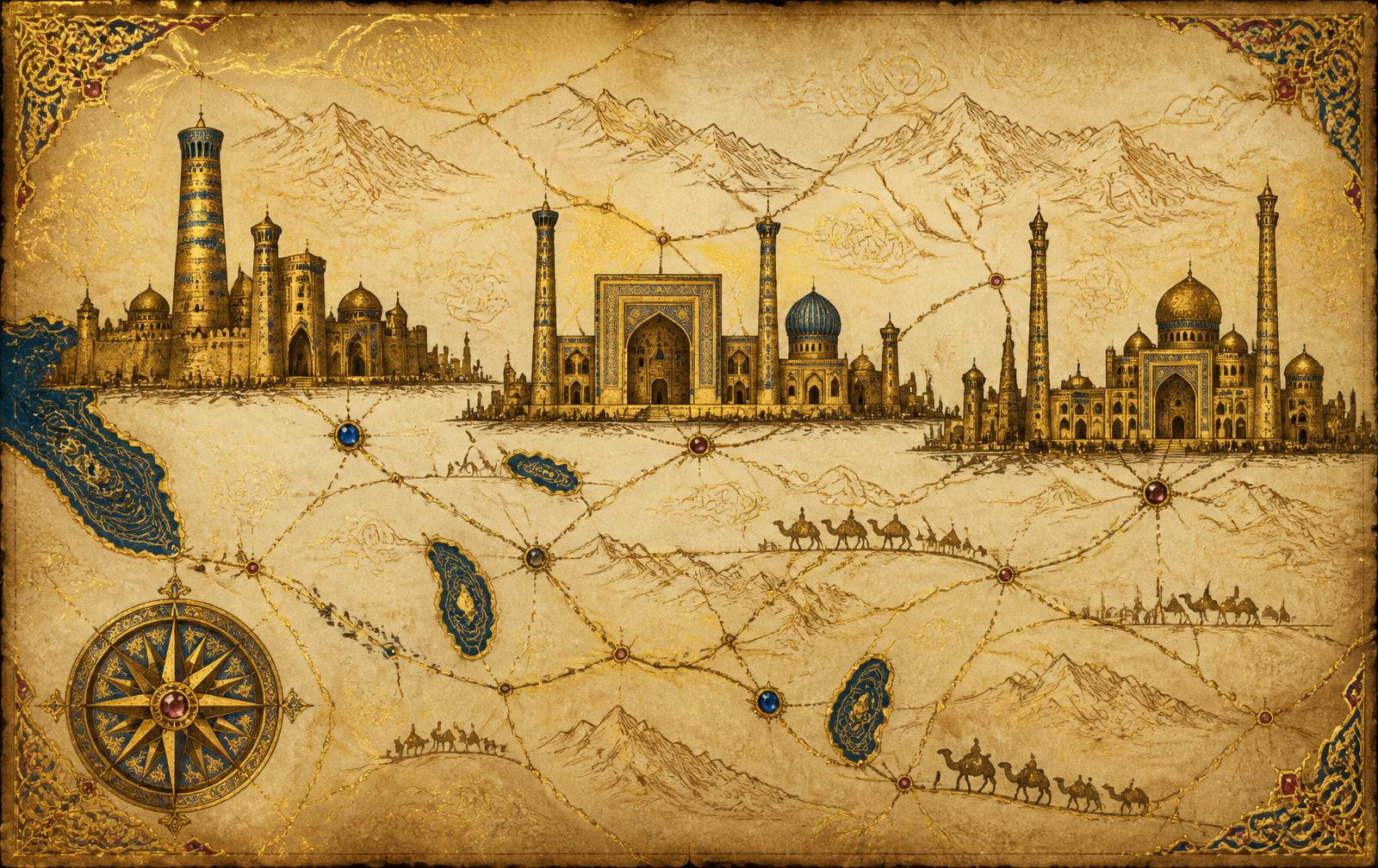
The Khwajagan
The Path of the Masters: Central Asian teachers, places, and teaching communities. It is not one uninterrupted medieval institution, but a living field from which the Yasawiyya and the later Naqshbandi world emerged.
Dates, places, texts, and relationships checked against modern scholarship.
Practices and sayings attributed to Khwajagan circles and later commentators.
Hagiography, shrine traditions, Bennett, Shushud, and contemporary accounts.
From Hamadan and Marv into Transoxiana
Yusuf al-Hamadani's teaching network linked Khurasan and Transoxiana. Later biographies name Ahmad Yasawi and Abd al-Khaliq Ghijduwani among his successors. The Atlas follows these relations with their evidence visible, rather than treating every later lineage diagram as a settled medieval fact.
Open the geographic atlasA discipline carried into ordinary life
The first eight phrases are traditionally ascribed to the Khwajagan current centred on Ghijduwani; three further forms of vigilance are associated with Baha al-Din Naqshband. Together they became the well-known eleven principles of the later order. They are a vocabulary of spiritual practice, not a substitute for the distinct practices of every Central Asian order.
From the Path of the Masters to the Naqshbandiyya
Bahāʾ al-Dīn Naqshband inherited a Khwajagan world of companionship, work, inward remembrance, and Bukhara-oasis shrines. His principal human teacher, Sayyid Amīr Kulāl, stands at the visible threshold. Later Naqshbandi authors read the earlier masters as their ancestry; modern history asks us to keep that devotional continuity distinct from the later consolidation of an order bearing Naqshband's name.
Meet Baha al-Din Naqshband- 01 Khwajagan names a field of masters and remembered succession in Central Asia.
- 02 Baha al-Din's Bukhara circle gives that inheritance a durable devotional focus.
- 03 Later networks, writings, shrines, and branches make Naqshbandiyya a worldwide order.
Reverence with historical clarity
Hagiography and sacred memory are not discarded here. They are given their proper place alongside texts, scholarship, and community testimony. The map makes the distinction visible, so visitors can move through the tradition without losing either its depth or its historical texture.